 by
by These have been my go-to pie crust recipes for decades. The original recipes came from a Better Homes and Gardens Cookbook that my Mom gave me in December 1990. I had been back to Missouri visiting for the holidays that year, and had used my Mom’s cookbook while I was there, and loved it… so she sent me a copy of it. Over the years, I’ve made it with Vegan Butter substitute (i.e. Earth Balance sticks), regular butter, and shortening, and it always turns out good. For me, this has always made a perfect pie crust.
The double pie crust recipe does not exactly double the flour from the single pie crust recipe even though all of the other ingredients are exactly double…. and this is how both recipes were originally written in the cookbook. However, both the single and double recipes always turn out well for me. I do think that the texture of the double pie crust turns out a slightly better than the single (because of the extra butter vs flour ratio); however, it’s not a huge difference in texture.
I generally think that a good pie crust is more about technique than anything else, so I added some suggestions down in the Notes section of the recipe. Most important- you want your butter and water to be as cold as possible, and don’t overwork the dough. 🙂


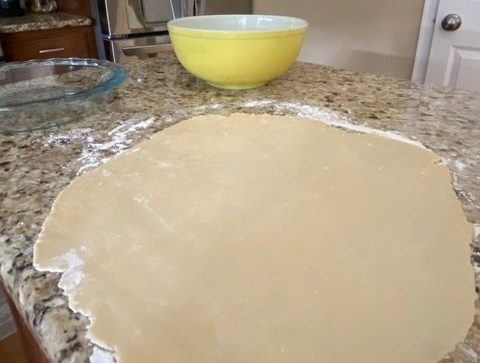
After making the dough, roll it into circle large enough to fit into your pie plate with a few inches of overhang. For a 9″ (23 cm) pie, I usually roll it into about a 12″ (30 cm) circle. For a 10″ (25 cm) pie, I usually roll it into about a 14″ (35 cm) circle. However, I never measure it, I just eyeball against the the size of the pie plate.
To move your dough to the pie plate: Roll the pie crust loosely around your rolling pin. Move the rolling pin over your pie plate- placing it so that when you unroll it, the dough will be centered in the plate. Carefully unroll and arrange it to fit…being careful not to tear or stretch the dough. Then cut the extra dough off leaving about 1/2″ (1.25 cm) overhang around the pie pan. You can then fold under the extra pastry, and create a pretty crimp around the edges of the pan.
If you are making a double pie crust, trim the bottom crust to the edge of the pie plate, and then when you cover with the top crust, fold under the extra pastry from the top crust, and create a pretty crimp around the edges of the pan.
I like to reroll the leftover scraps of dough, and cut them with plunger cookie cutters that have intricate designs (i.e. Leaves, snowflakes, etc). They make a pretty addition to the edges of the pie.

For my Vegan Pumpkin Pie, I placed the cutouts on a cookie sheet, and sprinkled them with a mixture of granulated sugar & pumpkin pie spice (1 part spice to 4 parts sugar), and baked in a 350 degrees F (177 degrees C) oven for 10 minutes. I then arranged them around the baked pie.


Pastry for Single or Double Pie Crust
Ingredients
Pastry for Single-Crust Pie
- 1 ¼ Cup All-Purpose Flour
- ¼ Teaspoon Salt
- ⅓ Cup Vegan Butter Substitute (cold) (i.e. Earth Balance sticks)
- 3-4 Tablespoons Ice Cold Water
Pastry for Double-Crust Pie
- 2 Cups All-Purpose Flour
- ½ Teaspoons Salt
- ⅔ Cup Vegan Butter Substitute (cold) (i.e. Earth Balance sticks)
- 6-7 Tablespoons Ice Cold Water
Instructions
- Place ice and water in a glass to get cold, and set aside. (You aren't going to use the ice to make the pie crust, you just want to get the water as cold as possible)
- In a medium sized mixing bowl, stir together the flour and salt
- Cut in Vegan Butter substitute until pieces are the size of small peas. I find it easiest just to use clean hands (sans rings, of course :-)) to cut the vegan butter into the flour, rather than using a pastry cutter.
- Sprinkle tablespoons of the water over the flour mixture, and toss gently with your hands or a fork until it is all moistened. You don't want to overmix the dough, though (overmixing will make the pie dough tough); just mix until all the flour mixture is moistened enough to form a ball. Use just enough of the water to moisten it enough to stick together, but you do not want your dough too wet.
- If making double pie crust recipe, divide the dough in half and squeeze each half into a ball. If making single pie crust, leave it as a single dough ball.
- On a lightly floured surface, flatten the dough ball a little. Then roll dough from the center to the edges, forming a circle about 12" – 14" (30-35 cm) in diameter (depending on size of your pie plate).
- Wrap the pastry around the rolling pin. Then unroll is onto a 9" or 10" (23 cm or 25 cm) pie plate, and form it into the plate being careful not to stretch or tear the pastry.
- For a single crust, trim the pastry to ½" (1.25 cm) beyond the edge of the pie plate, then fold under the extra pastry. Make a fluted, rope-shaped, or scalloped edge. Do not prick the pastry with a fork. (for the single crust, you can either bake prior to filling or after, depending on what type of pie you are making).
- For the double crust, trim the bottom crust of the pastry to the edge of the pie plate. Roll out the remaining dough for the top crust, and cut slits in the pastry to allow steam to escape. Fill the pastry in pie plate with desired filling. Place top crust on filling. Trim top crust ½" (1.25 cm) beyond edge of plate. Fold top crust under bottom crust; flute edge.
- Bake as directed in individual recipes.
Notes
- Make your water as cold as possible to help achieve a flaky pie crust.
- I like to fill a cup with ice & water, and let it get super cold.
- Throw away the ice before you spoon the water into the flour mixture.
- It also helps to have your butter substitute as cold as possible…. so don’t let it sit out on the counter to soften.
- You can also use regular butter or shortening in this recipe.
- Use just enough of the water to moisten the flour mixture enough to stick together, but you do not want your dough too wet.
- I live in an area with very low humidity, so I always seem to use all 4 Tablespoons of water
- However, if you live in a humid climate, you may only need 3 Tablespoons of water,
- Do not overmix.
- Handle it just enough to form it into the dough.
- Overmixing will make a tough pie crust.
- I always save the dough that I cut off the pie to make cute dough cut-outs to put around the edge of the pie (i.e. leaves or snowflakes, etc).
- I squeeze the scraps together back into a dough ball (knead it as little as possible -just enough to form it back into a doughball), reroll the dough, and cut out using small cookie cutters.
- You can either leave them plain or sprinkle the cutouts with sugar, and or spiced (i.e. cinnamon, or pumpkin pie spice, etc) sugar before placing them around the edge of the pie.
- The standard ratio for cinnamon sugar (or pumpkin pie spice sugar) is 1 part spice to 4 parts granulated sugar. If you want a stronger spice flavor, then you can do 1 part spice to 3 parts sugar.
- The cutouts can be added to the unbaked pie, and baked along with the pie. Or you can place the cutouts on a baking sheet, and bake at 350 degrees F (177 degrees C) for 10 minutes, and then place them around your baked/finished pie.
- If you don’t want to make cut-outs with the leftover dough pieces, I recommend brushing the leftover pieces with melted vegan butter, sprinkle with a cinnamon-sugar mixture. Place them on a baking sheet and bake at 350 degrees F (177 degrees C) for about 10 minutes. Nom… Nom… a very yummy snack while you are waiting for your pie to bake and cool! 🙂
- I use the same pie crust recipe for both my 9″ (23 cm) shallow or 10″ (25 cm) deep dish pie plate because I like my pie crust rolled thin, and I find that the same recipe always works no matter which pie plate I’m using.